
Explore how poor business VoIP management can lead to serious network vulnerabilities. Learn why proactive VoIP management is essential for security.

November 18, 2026
Treating zero trust as a completed project leads to a gradual decline in security, allowing old vulnerabilities to resurface. Only ongoing attention keeps your defenses strong.
A stalled zero trust rollout does not just sit idle; it quietly hands attackers an opening.
Permissions that should have expired stay active, newly added systems skip the rules everyone else follows, and the cost shows up later as a breach, a failed audit or a client who no longer trusts the business with their data.
That outcome is avoidable, but only if zero trust is understood correctly from the start. It is not a single project with a neat checklist but a security model that changes how a network and its data get protected, and because the process never really ends, treating it as a one-time task creates the very risks it was meant to close.
At its core, a zero trust approach refuses to assume any user or device is safe simply because it sits inside the network; every access request gets verified, every time, which is the mindset that separates it from traditional security models. Keep that mindset alive and defenses stay strong. Let it slip into a project with an end date, and the security posture weakens quickly enough for old vulnerabilities to resurface.

Most organizations start strong, investing in new tools and processes and marking the initial rollout as a milestone worth celebrating. Yet zero trust was never meant to be a one-time upgrade, and treating it as one is where the trouble begins.
Threats do not hold still long enough to let that mistake go unpunished. Attackers keep probing for new ways in, technology keeps shifting under everyone's feet, and a zero trust architecture that stops improving starts falling behind — what protected the network last year offers no guarantee for tomorrow.
Keeping pace means regularly updating policies, technology and user training; skip that ongoing attention and gaps open up, often the exact same ones traditional security once failed to close.
A zero trust security model is only as strong as its weakest link, so the moment adaptation stops, that weak link turns into a target.
Some teams in Florida and beyond treat zero trust as a box to check: finish the initial deployment, then move on to other priorities. That shift in attention is exactly what creates a false sense of safety.
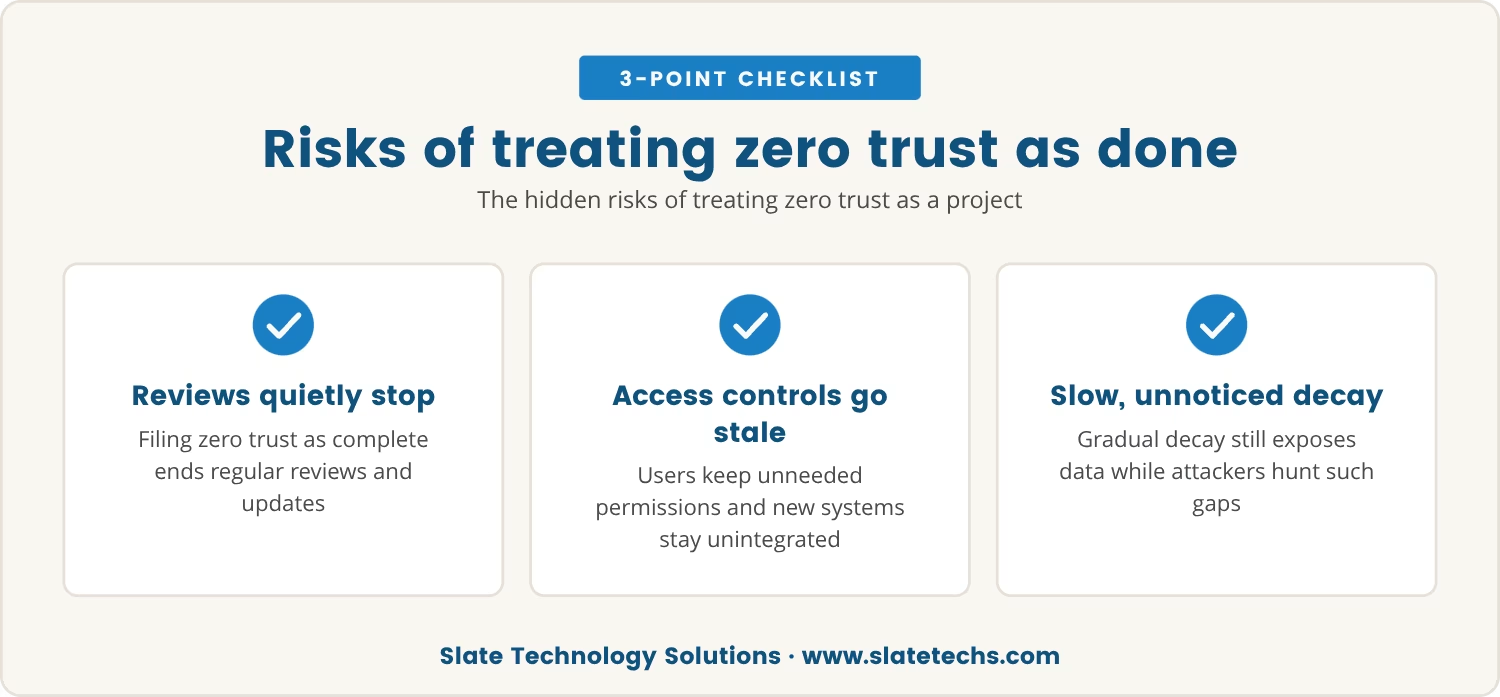
Once zero trust gets filed away as a completed project, the regular reviews and updates tend to go with it. Access controls grow outdated, users keep permissions they no longer need, and systems added after the initial rollout often never get folded into the original principles.
This decay moves slowly enough to escape notice, yet it leaves sensitive data exposed to unauthorized access all the same — and attackers are specifically hunting for overlooked gaps like these.
If your business has recently "finished" implementing zero trust, ask yourself: when was the last time you reviewed your access policies or tested your security controls?
Avoiding that decay means building zero trust into daily operations rather than leaving it as a one-off event. A few practical habits keep the posture strong over time:
Making these steps routine is what keeps an organization from sliding back into the same traps that traditional security models could never fully address.
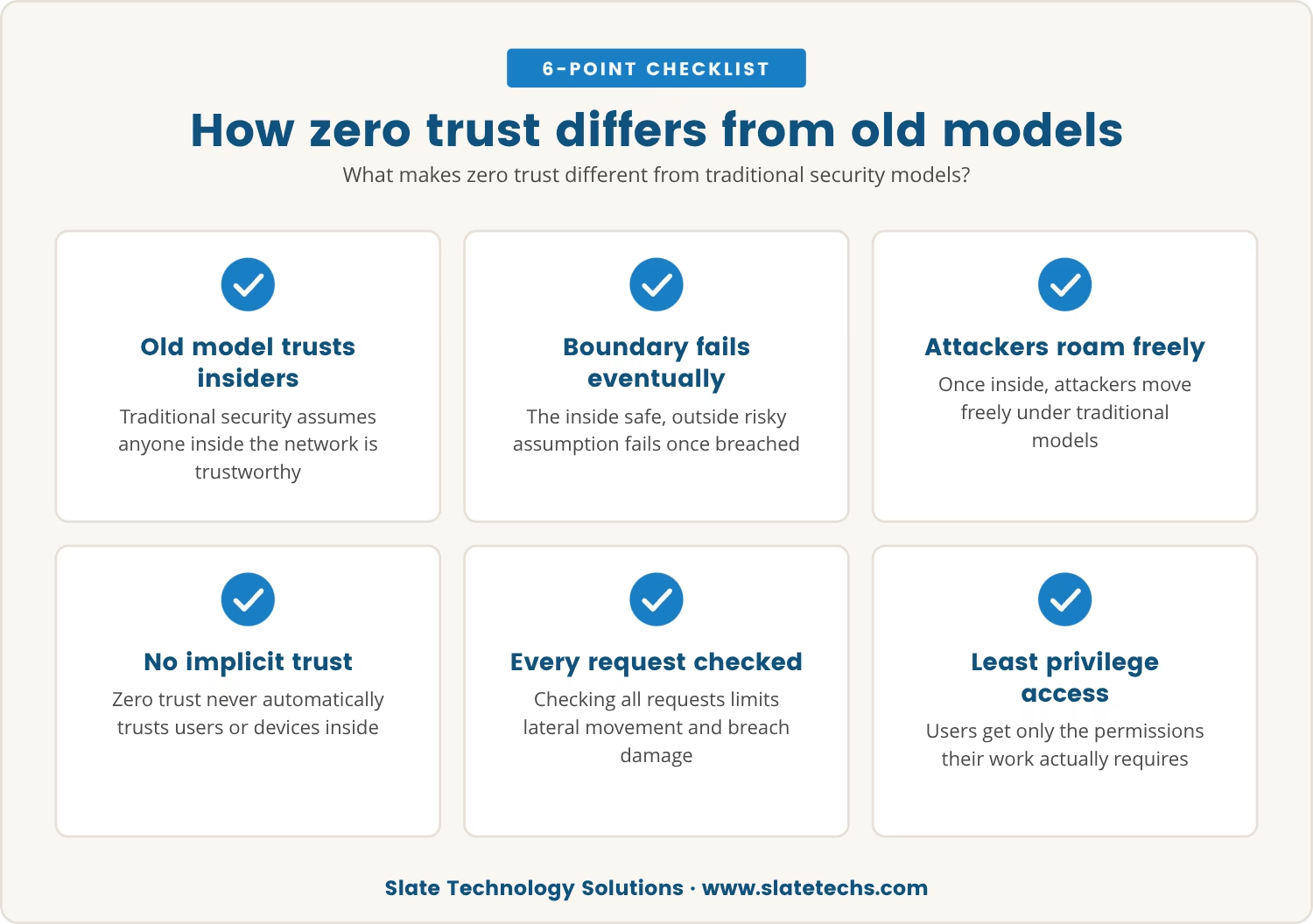
Zero trust turns the old security mindset on its head, since traditional models tend to assume that anyone already inside the network can be trusted. That assumption draws a clear boundary — inside is safe, outside is risky — which sounds reassuring right up until it fails.
Attackers have learned exactly how to cross that boundary, and once inside, they move around freely under the old model. Zero trust closes that path by never granting implicit trust, even to users or devices already inside the network.
Every access request gets checked no matter where it originates, which cuts down the risk of lateral movement and limits the damage even when an attacker does get in.
Underpinning all of this is least privilege access: users receive only the permissions their work requires, nothing more, which makes reaching sensitive data significantly harder for an attacker.
Zero trust holds up only when every part of an environment stays aligned with its principles, and a few areas tend to drift first.
Skip regular updates to who can access what, and old permissions linger. Each one left behind gives attackers another way in.
Older systems often cannot support modern security controls. Left out of the zero trust framework, they become standing weak spots.
New devices join the network constantly, and any that never get brought under zero trust policies introduce risk the moment they connect.
Without continuous monitoring, suspicious activity slips by unnoticed — exactly the blind spot attackers look to exploit.
Staff who are never trained on zero trust principles remain vulnerable to phishing and other attacks that sidestep technical controls entirely.
Passwords alone no longer cut it; multi-factor authentication needs to be updated and enforced everywhere, not just where it is convenient.
What separates a strong zero trust security model from a weak one ultimately comes down to commitment, since zero trust is a journey rather than a destination, demanding regular attention, updates and testing.
Businesses that treat it as a permanent shift keep their defenses current, while those that treat it as a finished project risk reopening the very gaps that traditional security could never close.
Folding zero trust into daily operations, rather than setting it aside once deployed, is what keeps a security posture strong — protecting sensitive data, supporting compliance, and building the kind of trust clients and partners notice.

If your business has between 45 and 100 users, you may be wondering if your zero trust approach is still as strong as it was on launch day. At Slate Technology Solutions, we understand how easy it is for security to slip when zero trust is treated as a finished project.
We invite you to see how our team keeps zero trust models current and effective, or to talk with us about your own setup and where it stands today.
Sign a 3-year contract with us, and you’ll receive 3 months of service free—an easy way to keep your zero trust journey moving forward.
Zero trust requires verifying every access request regardless of where it originates, so users and devices are never assumed safe simply because they sit inside the network. Access gets granted based on strict rules, only after identity and context are confirmed, which helps prevent unauthorized access and reduces the risk of internal threats.
Regularly review security policies, update technology, and provide ongoing staff training, pairing that with scheduled audits that check for gaps. New systems or devices need to be folded into the zero trust framework as they appear, since staying proactive is what allows the organization to adapt to new threats and hold onto a strong security posture.
Least privilege access means users receive only the permissions their job requires and nothing beyond it, which limits the damage a compromised account can cause. Cutting away unnecessary access makes it considerably harder for attackers to reach sensitive data or move laterally within the network.
Yes — zero trust is built specifically to stop lateral movement. Verifying every access request and limiting permissions prevents attackers from roaming freely once inside, and continuous monitoring paired with strict authentication makes it far harder for a threat to spread further.
Security controls deserve a review at least quarterly, or any time systems, users or business processes change. Regular reviews catch outdated permissions, surface new risks, and keep a zero trust implementation effective rather than letting it quietly drift out of date.