
Explore how poor business VoIP management can lead to serious network vulnerabilities. Learn why proactive VoIP management is essential for security.

November 18, 2026
Weak VoIP management doesn't just cause call problems—it can quietly open a path for attackers to access your entire business network. Overlooking VoIP security creates risks that often stay hidden until real damage is done.
Picture a receptionist's phone rebooting on its own at 2 a.m., then a string of international calls appearing on next month's bill that nobody in the office placed. That scenario sounds minor until you trace where it leads.
A large majority of business wireline connections now use interconnected VoIP, which means a glitch like that one isn't an isolated phone problem—it's happening inside a system that now carries the bulk of daily business communication. Because business VoIP sits so close to the center of operations, what looks like a call-quality hiccup can actually be the first visible sign of something larger.
Most VoIP management conversations stop at call quality and uptime, as if those were the only things worth protecting. Yet the more important question is what happens when those basics get treated as the whole job. Left unmanaged, the consequences stretch well past dropped calls or a few seconds of static.
A well-managed VoIP system keeps business running smoothly, while weak oversight does the opposite: it opens gaps that sit unnoticed. Those gaps don't announce themselves immediately—they accumulate quietly until they become real security exposures.
Seeing VoIP as part of the network, rather than a separate phone matter, is what makes those risks visible in the first place. Once the bigger picture is in view, it becomes much easier to catch a risk before it turns into an incident.
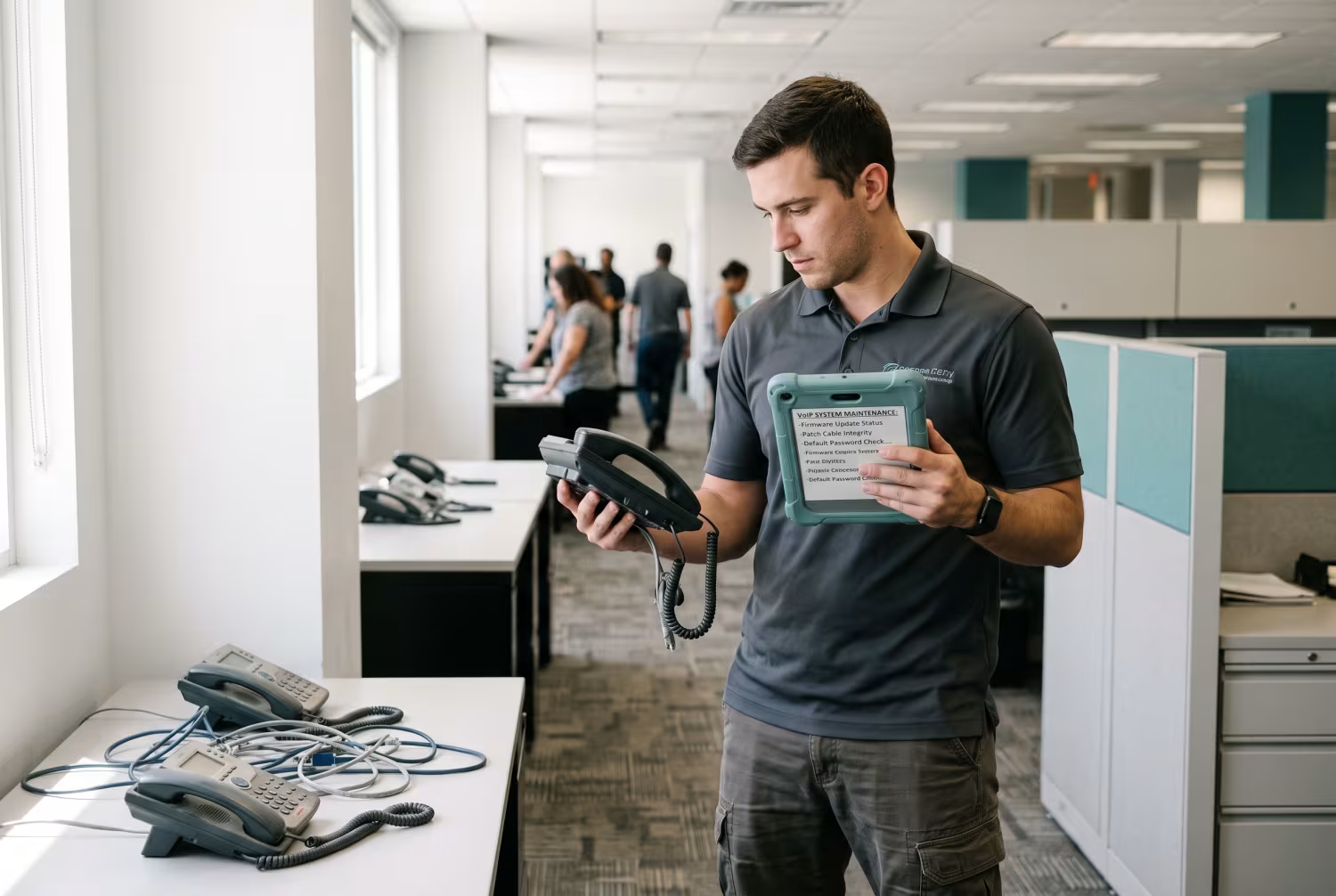
When VoIP management falls short, the fallout rarely announces itself right away. A missed call here, a minor glitch there—nothing that looks urgent on its own. The real danger sits underneath: small weaknesses in the VoIP setup quietly undermining the entire business phone system.
Unpatched software, outdated configurations, and neglected user accounts are exactly that kind of weakness. None of them looks serious in isolation, which is precisely why attackers scanning for a way into a network find them so useful.
Consider VoIP phones that haven't been updated in months. Attackers actively scan for devices with known weaknesses, and a neglected VoIP system practically advertises itself as an easy target.
The same logic applies to weak passwords on VoIP accounts—they're a door, not a speed bump. Once someone gets through it, they can listen in on calls, pull sensitive information out of conversations, or use the compromised system as a launchpad against other parts of the network.
What makes this genuinely risky is the lag between cause and effect: these problems tend to go unnoticed until they've already done damage. By the time that damage surfaces, the cost to the business is far higher than a few lost calls would ever suggest.
VoIP systems don't operate in isolation; they're wired into the larger IT environment. That connection is exactly why a weakness in the VoIP setup can serve as a starting point for a much broader attack. Once attackers get a foothold in a VoIP phone or server, they often look for a path deeper into the business network.
Picture a VoIP phone sharing a network segment with business-critical servers. A single compromised device on that segment can hand an attacker a route straight to sensitive company data—so the stakes are never just about phone calls, but about everything that phone can reach.
That's why VoIP management has to mean more than maintaining call quality. It calls for regular monitoring, timely updates, and strong access controls—skip those, and the VoIP system turns into an unguarded entry point.
In Florida, where many businesses lean on remote work and distributed teams, this risk compounds further. Employees connecting from different locations add devices and networks to the mix with every login, and each new connection is one more point that has to be managed rather than assumed safe.
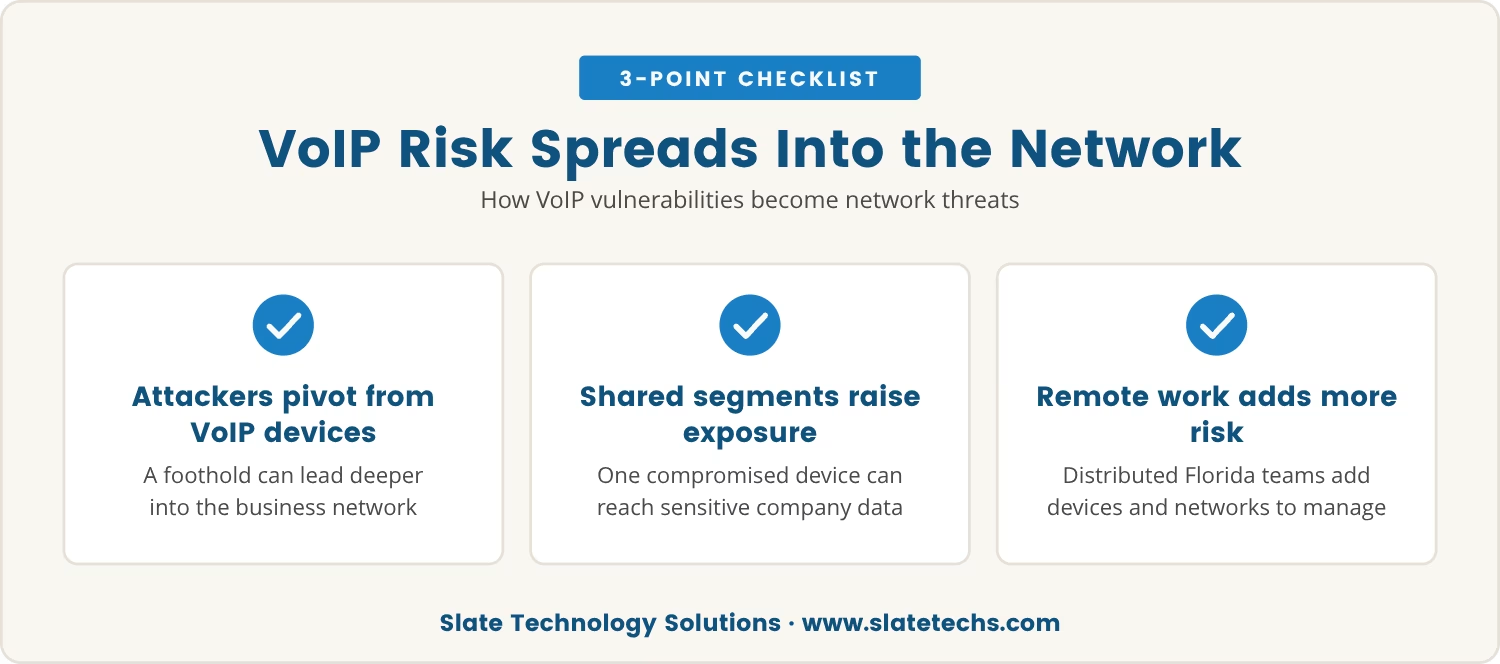
Many companies still treat their VoIP system as something separate from core IT infrastructure, and that separation is the mistake itself. VoIP phones, servers, and software are every bit as much a part of the network as the computers and databases sitting alongside them.
Even with managed VoIP solutions in place, reliability and security aren't automatic. Unless updates, user permissions, and monitoring are actively managed, hidden weaknesses can persist unnoticed—VoIP management isn't a task that stays finished once it's done.
Consider your own setup for a moment: are the VoIP devices updated as often as the rest of the business systems? If the honest answer is no, there's likely a gap sitting open right now.
A strong VoIP management plan closes that gap with regular software updates, strict password policies, and ongoing monitoring for unusual activity—the combination that keeps communication tools from becoming the weak link in an otherwise solid network.
Even businesses with good intentions overlook the same handful of areas, and those recurring blind spots are worth naming directly:
None of these looks dangerous by itself, but stacked together they add up to a serious vulnerability in the business phone system.
Traditional phone lines sat mostly isolated from the IT network, which limited how far a problem could spread. VoIP breaks that isolation by design, integrating deeply with business technology—and that same integration that delivers advanced voip features and easier scaling is what introduces new risk alongside the benefit.
With VoIP, every phone is a network device, not just a handset. That means each one needs the same attention given to a computer or server, since a single misconfigured phone is enough to create an opening for attackers.
Complicating matters further, VoIP technology evolves quickly, with new features and updates arriving on a regular cadence. Keeping pace takes a proactive approach, and managed VoIP solutions only deliver on that promise if someone is actively maintaining them.
The bottom line is that VoIP management is an ongoing process, not a one-time setup. Regular attention is what keeps the system secure and business communication running without interruption.
Catching trouble early is what keeps a small issue from becoming a costly one. The following signs are worth treating as early indicators that a VoIP system is at risk.
A sudden spike in international calls or calls placed at odd hours can signal that someone is abusing the system.
While this can be a technical issue, it may also point to unauthorized activity or system tampering.
Phones or servers restarting without explanation could mean someone is trying to install unauthorized software.
If new user accounts or devices appear connected to the VoIP system, that calls for immediate investigation.
Warnings about unusual traffic or failed login attempts should never be ignored.
Sometimes attackers use a system's resources for their own purposes, and that misuse degrades performance for everyone else relying on it.
Fixing these gaps doesn't require an overhaul—it starts with a handful of practical, concrete steps:
Taken together, these actions close the exact gaps that leave a business exposed.
The real cost of weak VoIP management isn't inconvenience—it's the risk of exposing an entire network to threats that proactive management could have stopped. Left unaddressed, small oversights compound over time into major vulnerabilities.
Treating VoIP as a core part of the IT environment protects more than calls; it protects the business as a whole. The sooner these risks get addressed, the better the odds of avoiding a costly incident later on.

Many businesses with 45 to 100 users rely on VoIP but may not realize how quickly small management gaps can turn into bigger network risks. At Slate Technology Solutions, we understand how these issues can impact your daily operations and long-term security.
If you're unsure how your current VoIP management stacks up, let's talk about your setup or how we approach proactive monitoring and updates. We're here to help you keep your communications secure.
Sign a 3-year contract with us and get 3 months of service free—an easy way to strengthen your VoIP security while saving money.
A VoIP phone system uses your existing internet connection to make and receive calls, with each phone or softphone connecting to your network just like a computer or printer. This setup enables advanced features and flexibility, but it also makes every VoIP device part of your larger IT environment, so proper network configuration and security are essential to keeping communications safe.
Watch for unexpected call patterns, such as calls to unfamiliar international numbers, or sudden drops in call quality. Other warning signs include new user accounts you didn't create, devices rebooting without explanation, and alerts from your network monitoring tools, any of which should prompt an immediate review of your VoIP management practices.
Yes, managed VoIP solutions often include regular updates, monitoring, and support from experienced professionals who help you stay ahead of threats by handling software patches, watching for unusual activity, and keeping your system configured securely. Staying involved still matters, since reviewing your provider's practices is the only way to confirm your business needs are actually being met.
Look for a VoIP provider that prioritizes security features such as encryption, strong authentication, and regular updates, and ask about their track record with security incidents and how they handle vulnerabilities. A good provider should also offer clear support channels and practical guidance for keeping your system safe.
Some VoIP features, like call recording or voicemail-to-email, can introduce new risks if not properly managed, so access to them should be limited to authorized users and their configuration checked regularly. Reviewing which features are actually in use and disabling the rest is a simple way to reduce exposure.